
Lead Enrichment Tools in 2025, Comparing the Top Platforms and Metrics That Matter
Build a reliable pipeline with real-time enrichment, validated data, and actionable buyer intent signals.
 October 2nd, 2025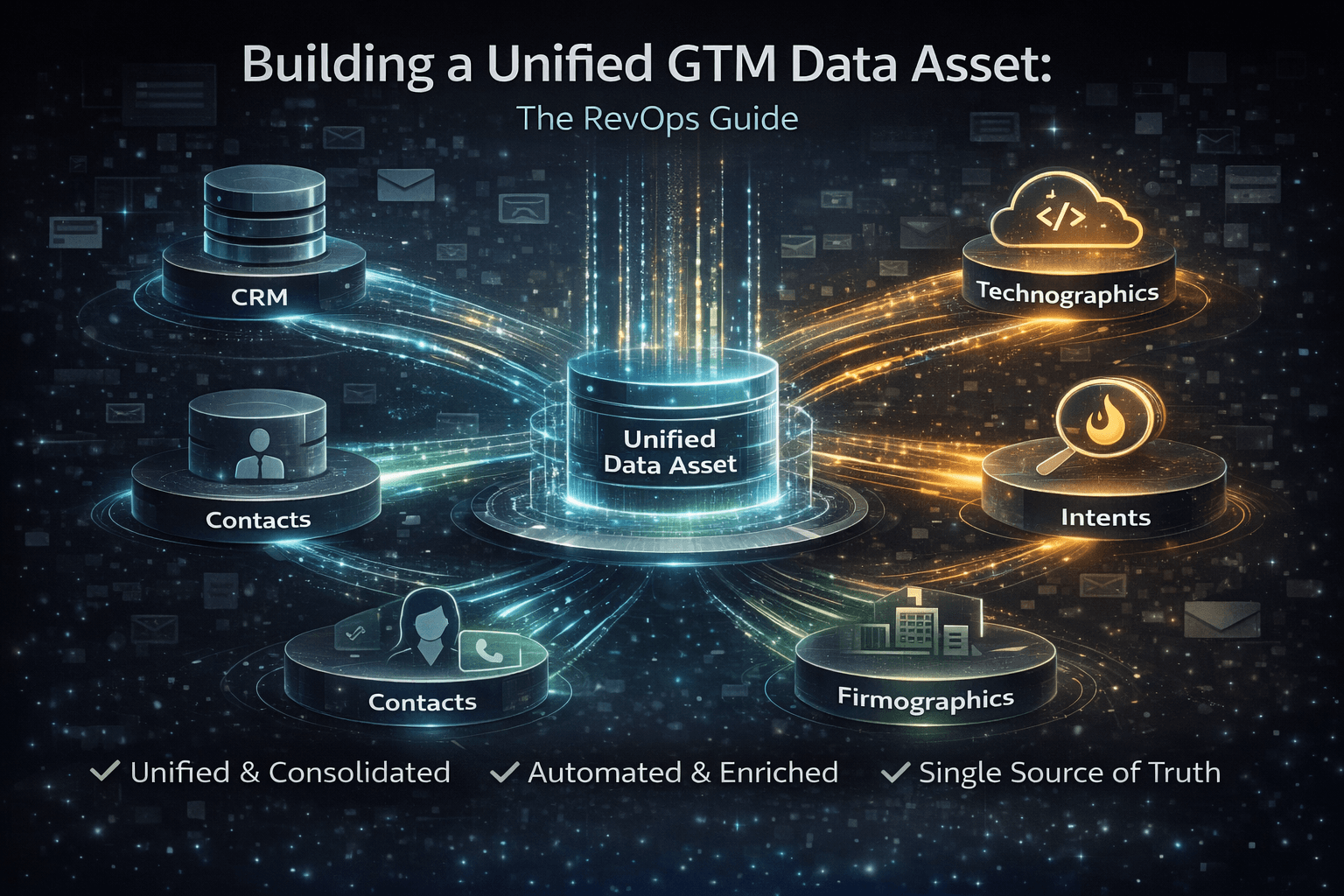
Stop struggling with data silos. Learn how to create a unified data asset by merging databases and automating your enrichment stack for better GTM.
For the modern GTM leader, data is no longer the bottleneck; coherence is.
Most Demand Gen and RevOps teams are currently drowning in a "Frankenstein" data stack. You likely have one provider for technographics, another for intent signals, a third for mobile numbers, and a messy CRM filled with legacy records. Individually, these tools are powerful. Collectively, they are often a source of friction, conflicting information, and wasted SDR hours.
The holy grail of a high-performance Go-To-Market engine is the unified data asset.
This is not just another database. It is a consolidated, cleaned, and orchestrated "Golden Record" that lives across your stack, ensuring that Marketing, Sales, and Success are all looking at the exact same version of your Total Addressable Market (TAM).
In this guide, we will explore why the traditional "multi-vendor silo" approach is failing and how you can build a unified data asset that scales your outbound and sharpens your targeting.
Historically, RevOps teams have been forced to play the role of manual data brokers. You buy a list from Vendor A, try to match it against intent signals from Vendor B, and then upload the mess into a CRM that is already struggling with duplicates.
The "old way" of managing GTM data is failing due to three specific pain points:
In short, when your data is fragmented, your GTM execution is fragmented.
The solution isn't to fire all your vendors and pick just one. No single data provider is 100% accurate across every field. The solution is to move toward an orchestration model using AI-verified data.
Instead of treating your CRM as a bucket for static lists, forward-thinking teams use Datakart’s approach to create a dynamic, unified layer. Here is how the methodology has evolved:
This shift transforms your data from a stagnant liability into a competitive weapon.
Creating a unified asset is a structural project, not a one-time upload. Follow this 6-step framework to build a self-healing enrichment stack.
Before you can unify, you must identify. List every source of data currently entering your CRM:
Decide which fields are non-negotiable for your GTM. This usually includes:
Not all databases are created equal. You might find that Provider A is excellent for European contact data, but Provider B is superior for North American technographics. Establish a hierarchy so your orchestration tool knows which source to trust first for specific fields.
Use an AI-powered tool to handle the dataset merging. This step involves "deduplication" on steroids—ensuring that every person and account is uniquely identified by a single ID across all your disparate sources.
CTA: Want to see your TAM in action? Try Datakart’s Free Audit to see how much of your current data is redundant or conflicting.
Your unified data asset should live in a central hub but sync bidirectionally with your CRM. Ensure that when a data point is updated in your intelligence layer, it triggers a CRM integration update so your SDRs always have the freshest info in their "Source of Truth."
Data decays at 2-3% per month. Your unified asset must have an "always-on" refresh cycle. If a contact changes jobs on LinkedIn, your unified asset should detect the signal, update the record, and notify the assigned account owner.
Consider a mid-market SaaS company, "SaaS-Flow," that was using three separate databases for their GTM.
Avoid these three pitfalls that typically derail unification projects:
To build a unified data asset, you need a stack that values connectivity over everything else.
Best Practice: Implement "Waterfall Enrichment." This is a process where your system attempts to find a verified contact from Source 1; if it fails, it moves to Source 2, and so on. This ensures maximum coverage without sacrificing the "Golden Record" quality.
The era of managing multiple, disconnected databases is over. In a market that demands efficiency, the "Silo Tax" is too high for any growth-stage company to pay.
Building a unified data asset allows your RevOps team to stop being manual data cleaners and start being strategic architects. By merging datasets, automating your enrichment stack, and leveraging AI-verified signals, you create a foundation for predictable, scalable revenue.
Stop wasting time in Excel and start activating your TAM. Book a personalized demo with Datakart and let us show you how to unify your GTM data into a high-performance engine.
A unified data asset is a single, centralized record of all your accounts and contacts, created by merging multiple data sources (intent, firmographic, technographic) and resolving conflicts using AI to ensure one "Golden Record" of truth.
Clean dataset merging significantly improves CRM performance by reducing duplicate records, improving searchability, and ensuring that automation (like lead routing) functions correctly based on accurate data.
No single data provider is 100% accurate. A multi-source enrichment stack allows you to "triangulate" the truth, using the strengths of different vendors to fill in the gaps and verify information across the board.
Because B2B data decays so quickly, your asset should be refreshed in real-time or, at a minimum, through weekly enrichment cycles to ensure your GTM team isn't acting on outdated signals.
Build a reliable pipeline with real-time enrichment, validated data, and actionable buyer intent signals.
October 2nd, 2025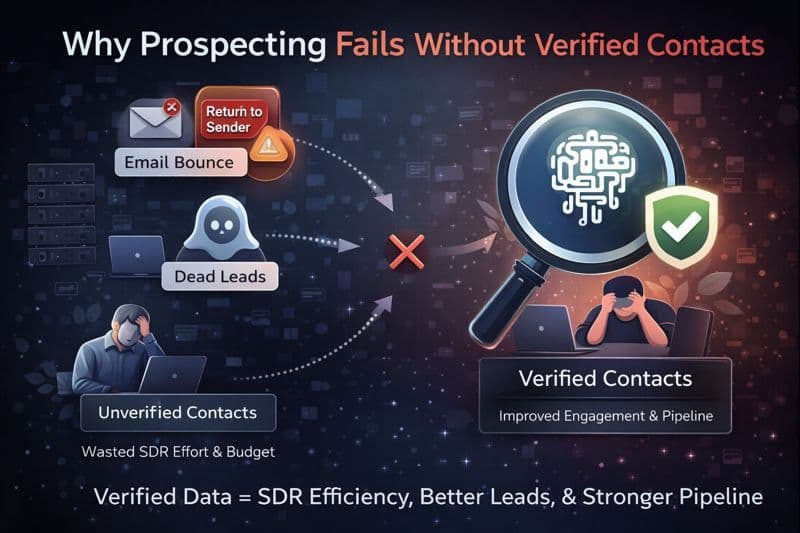
Stop wasting resources on dead leads. Discover how verified contacts improve SDR efficiency, outbound performance, and lead quality for B2B GTM teams.
January 20th, 2026
Learn how data enrichment improves contact accuracy, strengthens multi layer sourcing, and builds reliable data pipelines for GTM operations. Discover how platforms like Datakart.ai streamline enrichment workflows.
November 24th, 2025