
Lead Enrichment Tools in 2025, Comparing the Top Platforms and Metrics That Matter
Build a reliable pipeline with real-time enrichment, validated data, and actionable buyer intent signals.
 October 2nd, 2025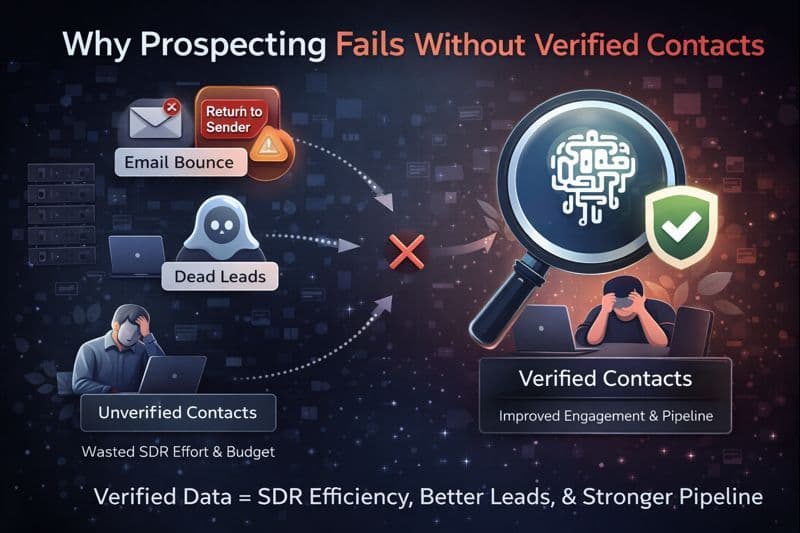
Stop wasting resources on dead leads. Discover how verified contacts improve SDR efficiency, outbound performance, and lead quality for B2B GTM teams.
In the current B2B landscape, the "growth at all costs" era has been replaced by the era of "efficiency at all costs." For Demand Gen Heads, GTM leaders, and Founders, this shift has put a spotlight on the single most expensive resource in the building: the outbound sales team.
If your Sales Development Representatives (SDRs) are hitting their activity quotas - 100 emails, 50 calls, 20 LinkedIn touches - but your pipeline is stagnant, you don't have an activity problem. You have a data problem.
Prospecting in 2026 is no longer a game of volume; it is a game of surgical precision. Yet, many teams are still operating with a "spray and pray" mindset, fueled by stale, unverified databases. The result? High bounce rates, burned domain reputations, and SDR burnout. To win, you must realize that verified contacts are not just a "nice-to-have" feature; they are the fundamental infrastructure of any successful engagement strategy.
Most GTM teams rely on legacy data providers that offer massive, static databases. On the surface, a list of 10,000 prospects looks like a goldmine. In reality, it is often a graveyard. Traditional data methods are failing for several critical reasons:
According to industry benchmarks from HubSpot, B2B data decays at a rate of roughly 2.5% per month. People change jobs, companies restructure, and email formats shift. Within a year, nearly 30% of your "perfect list" is obsolete. If you are prospecting into a database that hasn't been refreshed in 90 days, you are essentially throwing 10% of your SDRs' salary into a black hole.
We ask SDRs to be personalized and researched. But when an SDR spends 15 minutes researching a prospect, only for their email to bounce or their phone number to be a corporate switchboard that leads to nowhere, that time is irrecoverable. This lack of SDR efficiency leads to a "death spiral" where teams increase volume to compensate for poor lead quality, which only leads to more noise and lower conversion rates.
Sending emails to unverified addresses does more than just yield a "Return to Sender" notification. High bounce rates signal to Google and Microsoft that you are a "bad actor." Once your domain reputation is damaged, even your emails to valid prospects start landing in the spam folder. Without verified contacts, your entire outbound engine can be neutralized by a single bad list.
The transition from "data as a list" to "data as an intelligence layer" is what separates top-performing RevOps teams from the rest. At Datakart.ai, we believe the solution isn't just a larger database, but a dynamic, AI-verified approach to contact intelligence.
AI-verified data doesn't just check if an email format is "likely" correct. It uses real-time validation protocols to ping servers, analyze social signals, and cross-reference technographic changes to ensure the person you are reaching out to is actually in that seat today.
Verified data is most powerful when combined with intent. Instead of just knowing "who" they are, AI-driven platforms allow you to see "why" you should reach out. Has the company recently installed a competitor’s software? Have they increased their hiring in a specific department? By layering verified contacts over these signal insights, you transform a cold call into a warm, relevant conversation.
The best data isn't just scraped; it's triangulated. By using AI to process millions of data points and then employing automated verification loops, you can reach a level of accuracy (95%+) that was previously impossible. This methodology ensures that when your SDR hits "send" or "dial," they are connecting with a human, not a ghost.
To turn your outbound from a cost center into a profit engine, you need a framework that prioritizes lead quality over raw numbers.
Before you add more leads, look at what you have. Run a sample of your current CRM data through a verification tool. If your bounce rate is over 3%, or your direct-dial accuracy is below 60%, your foundation is cracked.
Don't prospect your entire Total Addressable Market (TAM) at once. Use technographics and intent signals to identify the top 10% of accounts that are "in-market."
A verified email is the baseline. To maximize outbound performance, you need verified mobile numbers and LinkedIn profiles. In a hybrid-work world, corporate landlines are virtually useless. Direct dials are the currency of successful prospecting.
Data freshness is a perishable resource. Set up your systems so that any lead entered into a sequence is automatically refreshed and verified at the moment of entry.
CTA: Want to see your TAM in action? Try Datakart’s Free Audit and see the actual health of your prospecting data.
Shift your SDRs' North Star metric from "Number of Outbound Activities" to "Number of Quality Conversations." When you provide verified contacts, the "Dial-to-Connect" ratio skyrockets, allowing SDRs to spend more time selling and less time searching.
Consider a Series B FinTech company that was struggling with its outbound performance. Their SDRs were making 60 calls a day but only averaging 1.5 meaningful conversations. They were using a well-known legacy data provider.
The Intervention: The company switched to a verified-first model, using Datakart.ai to enrich their target accounts. We identified that 35% of their CRM contacts were either no longer at the company or had incorrect email formats. Furthermore, only 12% of their records had a direct mobile number.
The Result: By replacing the "ghost data" with verified contacts, the team saw:
Even with the right intentions, many GTM leaders fall into these traps:
Your data intelligence platform should not be an island. To maximize lead quality, it must integrate seamlessly with your existing RevOps stack.
Best Practice: Implement a "Waterfall Verification" process. If one source can't verify a contact, have your system automatically check a second, more specialized source. This ensures maximum coverage without sacrificing the integrity of the data.
The difference between a failing prospecting effort and a high-growth engine isn't the talent of your sales team or the beauty of your slide decks. It is the quality of the fuel you put into the engine.
Without verified contacts, you are asking your team to run a race with weights on their ankles. By providing them with accurate, high-intent, and verified data, you unlock their true potential, protect your brand's digital reputation, and ultimately, drive the predictable revenue your board expects.
Most GTM teams are working with 60% accuracy at best. Are you ready to see what 95% looks like? Book a demo with Datakart today and let us help you turn your TAM into a pipeline reality.
Verified contacts are prospect records that have been validated through real-time checks (SMTP pings for emails, connectivity checks for phone numbers, and social signal analysis) to ensure the information is accurate and the individual is currently in the stated role.
Low connect rates are typically caused by "data decay." If your team is calling corporate switchboards or unverified landlines instead of direct mobile numbers, their efficiency will plummet. Switching to verified direct dials is the fastest way to improve SDR efficiency.
Because B2B data decays at ~2.5% per month, you should ideally verify your data at the point of entry into an outbound sequence. A quarterly "deep clean" of your entire CRM is also a best practice for maintaining lead quality.
Yes. By ensuring you only send emails to valid, active addresses, you keep your bounce rate low. A low bounce rate (typically under 2%) is one of the most important factors in maintaining high email deliverability and staying out of the spam folder.
Build a reliable pipeline with real-time enrichment, validated data, and actionable buyer intent signals.
October 2nd, 2025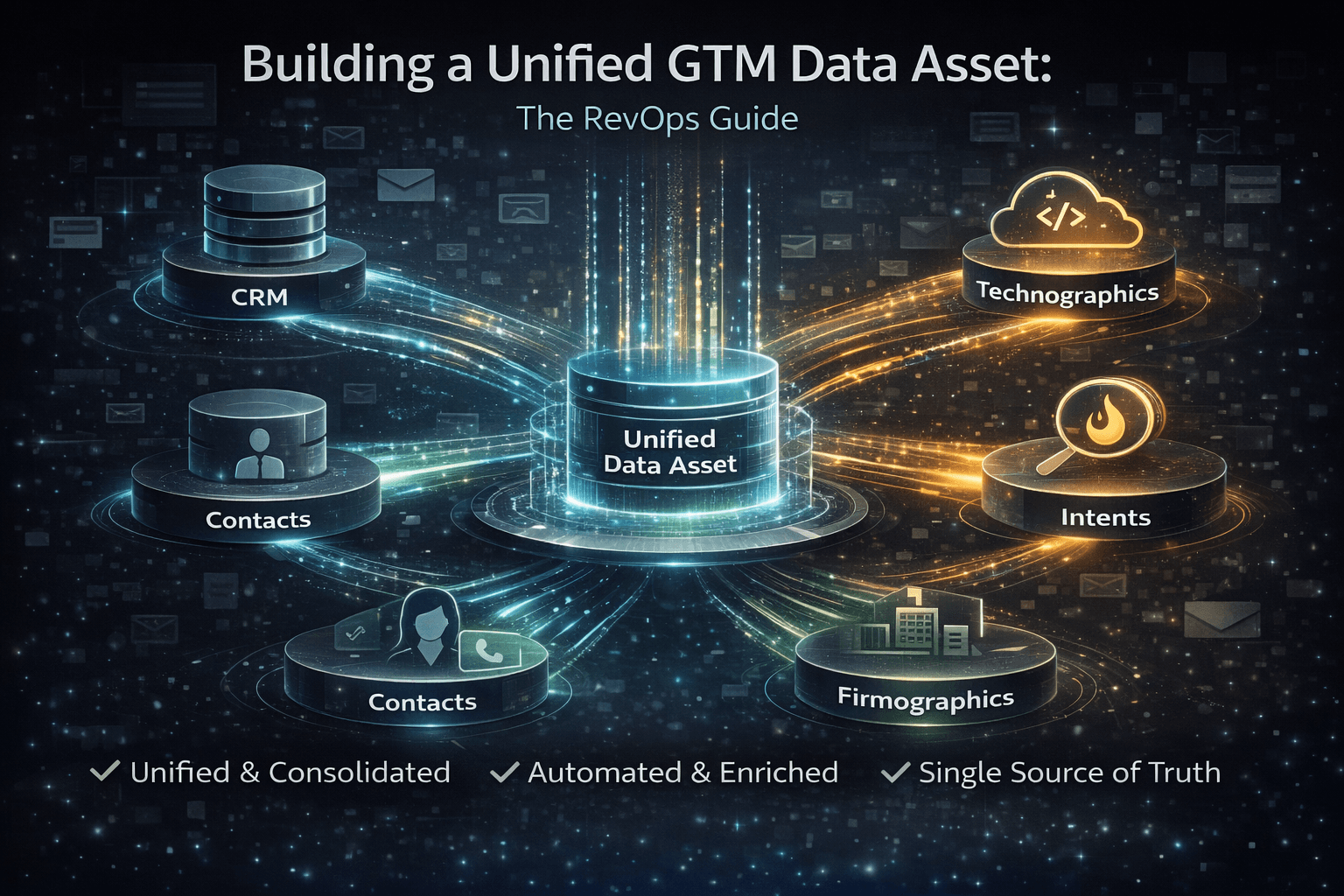
Stop struggling with data silos. Learn how to create a unified data asset by merging databases and automating your enrichment stack for better GTM.
January 20th, 2026
Learn how data enrichment improves contact accuracy, strengthens multi layer sourcing, and builds reliable data pipelines for GTM operations. Discover how platforms like Datakart.ai streamline enrichment workflows.
November 24th, 2025