
Lead Enrichment Tools in 2025, Comparing the Top Platforms and Metrics That Matter
Build a reliable pipeline with real-time enrichment, validated data, and actionable buyer intent signals.
 October 2nd, 2025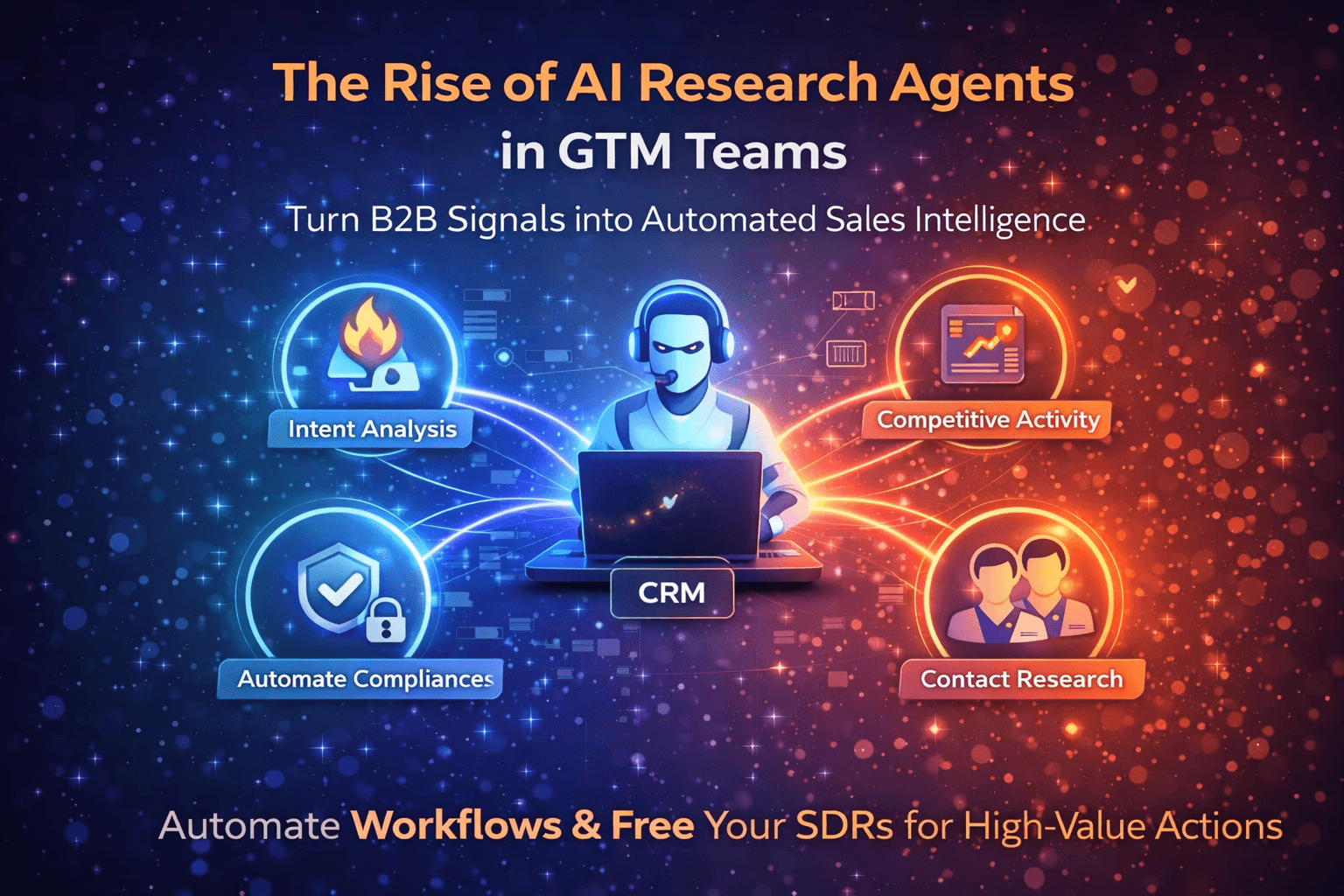
Stop wasting SDR time on stale leads. Learn how to maintain data freshness through continuous enrichment cycles and AI-powered profile refreshes.
In the high-stakes world of B2B SaaS, the "spray and pray" era of outbound is officially dead. For Demand Gen Heads and GTM leaders, the challenge in 2026 isn't a lack of data - it’s the sheer cognitive load required to make that data actionable.
Your SDRs are likely spending 60% of their day acting like amateur private investigators: scouring LinkedIn, reading 10-K filings, and listening to earnings calls just to write a single "personalized" email. This manual research is the single greatest bottleneck to pipeline velocity. It doesn't scale, it leads to rapid burnout, and frankly, humans are no longer the most efficient tools for data interpretation.
Enter AI research agents.
We are currently witnessing a generational shift from static databases to autonomous workflows. These agents aren't just "bots"; they are sophisticated AI entities capable of executing complex research tasks, synthesizing intent signals, and delivering ready-to-use insights directly into your sales sequences. For the modern GTM organization, AI research agents represent the move from "working harder" to "architecting systems" that sell.
Historically, GTM teams have relied on a two-tiered system: a massive, static database (the "Who") and a team of SDRs (the "Why"). This model is fundamentally broken for three reasons:
Traditional methods treat your sales team as a search engine. In 2026, that is a billion-dollar waste of human talent.
The solution isn't to stop researching; it’s to automate the "discovery" phase using AI research agents. At Datakart.ai, we see this as the "Agentic Layer" of the GTM stack.
Instead of a rep manually looking for a reason to reach out, an AI agent operates 24/7 as an autonomous research partner. This methodology upgrade focuses on three core pillars:
This shift allows your SDRs to move from "Researchers" to "Editors and Closers."
Deploying AI research agents requires a shift in RevOps strategy. Follow this 6-step framework to transition to autonomous prospecting.
Identify the 5-7 signals that historically lead to your best deals. Is it a new VP hire? A specific technology installation? A mention of "scalability" in an earnings call? These become the "mission parameters" for your agents.
Determine where the agent fits. A typical workflow looks like:
An agent is only as good as its inputs. Ensure your agent is pulling from a platform that provides real-time verified contacts to prevent "hallucinating" insights for non-existent leads.
Don't let the agent send emails directly yet. Feed the agent's research into your sales engagement tool (like Outreach or Salesloft) as a "custom variable." Your SDR then reviews and "edits" the final 10% to add a human touch.
CTA: Want to see your TAM in action? Try Datakart’s Free Audit to see which accounts are showing the highest intent signals right now.
Use the agent to "score" the research. Have the agent provide a 1-10 "Relevance Score" based on the insights it found. This allows SDRs to prioritize their day based on the strength of the insight, not just the size of the company.
When a meeting is booked, feed that "Success Signal" back to the agent. This allows the AI to learn which types of research/insights are actually resonating with your specific persona.
Consider "DevScale," a hypothetical DevOps SaaS company. They were struggling with a 1% reply rate on their "personalized" outbound. Their SDRs were spending 20 minutes per lead on manual research.
The Intervention: They deployed AI research agents to monitor the GitHub activity and job boards of their top 500 target accounts. The agents were tasked with finding:
The Result: The agents identified that 45 of their target accounts were currently struggling with a specific legacy framework. The SDRs received a notification with the exact GitHub link and a suggested talking point. The company saw a 20% increase in connect rates and tripled their qualified pipeline within one quarter. The SDRs didn't work more hours; they just had better "intel" for every conversation.
Even with advanced AI, GTM leaders often trip up on these three areas:
To run AI research agents effectively, you need a stack that is modular and API-first.
Best Practice: Treat your agents like employees. Give them "Performance Reviews." If an agent is consistently finding insights that don't lead to meetings, refine its "Prompt Instructions" and "Source Material."
AI research agents are not here to replace SDRs; they are here to liberate them. By automating the "detective work" of prospecting, you allow your sales team to do what they do best: build relationships, handle objections, and close deals.
In a world of noise, the winner is the team that can interpret data the fastest and turn it into a meaningful conversation. The transition to autonomous workflows isn't just a trend - it's the new standard for B2B excellence.
Stop forcing your humans to act like machines. Build a high-precision outbound engine that scales without the burnout. Book a demo with Datakart today and see how we can fuel your AI strategy with the world's most accurate data.
AI research agents are autonomous or semi-autonomous software entities that use LLMs (Large Language Models) to browse the web, analyze documents, and interpret signals (like hiring or news) to provide actionable insights for sales and marketing teams.
Standard SDR automation is usually just "timing" (e.g., send email 2 days after email 1). Agents add "context" to that automation by finding specific, personalized reasons for the outreach, making the automation feel human and highly relevant.
Data interpretation is the ability of an AI to not just see a data point (e.g., "Company X is hiring") but to understand the implication (e.g., "Company X is likely expanding their security team and will need new firewall software"). This allows for much more strategic prospecting.
Yes. Most modern AI agents are designed to pull data from and push insights back into major CRMs like Salesforce and HubSpot, ensuring your autonomous workflows are fully integrated with your source of truth.
Build a reliable pipeline with real-time enrichment, validated data, and actionable buyer intent signals.
October 2nd, 2025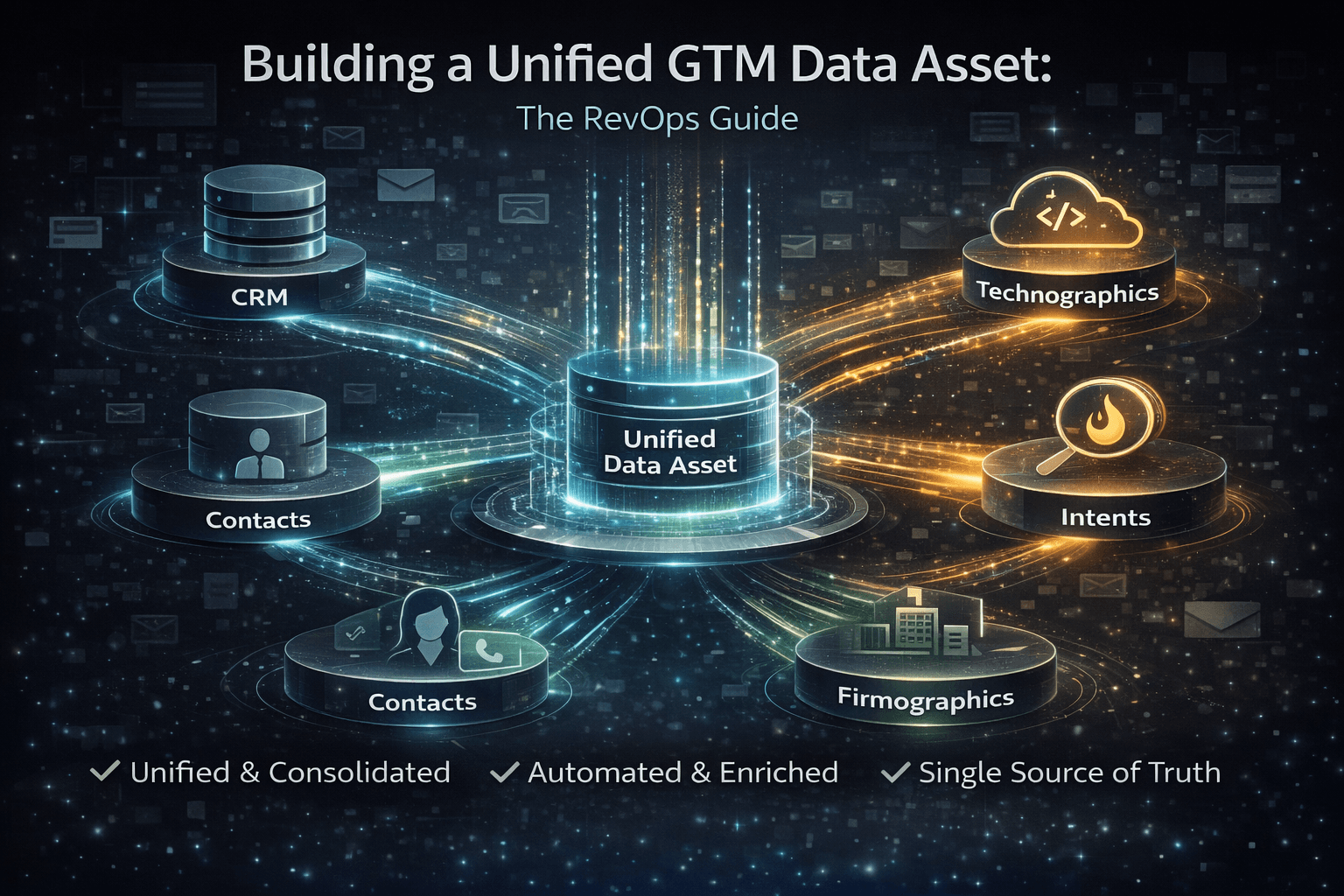
Stop struggling with data silos. Learn how to create a unified data asset by merging databases and automating your enrichment stack for better GTM.
January 20th, 2026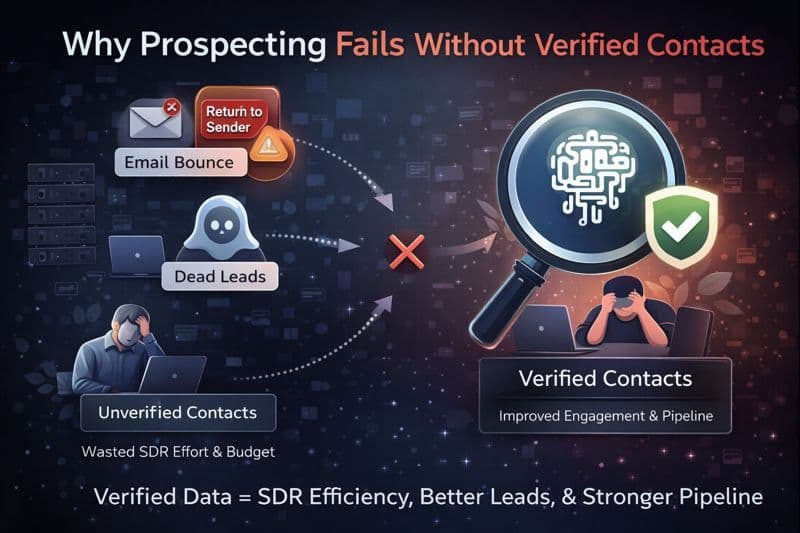
Stop wasting resources on dead leads. Discover how verified contacts improve SDR efficiency, outbound performance, and lead quality for B2B GTM teams.
January 20th, 2026